By Luka Milidragovic, Director and Condominium Finance Specialist at Condominium Lending Group. This article expands on my feature “Funding the Unexpected” in the Fall 2026 issue of CM Magazine, published by the Association of Condominium Managers of Ontario (ACMO). The cover image is an AI illustration, not a real building.
A condo reserve fund shortfall is a gap between the money in the fund and the cost of the work it has to pay for. The Condominium Authority of Ontario (CAO) says the primary strategy for funding a reserve fund is to raise contributions gradually. A major project often needs money sooner than that can deliver. In that case an Ontario board typically weighs three options: defer the repair, levy a special assessment or borrow through a condominium corporation loan. Boards can also combine them. Each option changes when the money is paid and which owners pay it.
Key points
- A reserve fund study is a forecast, so a shortfall can appear between studies even when a corporation follows its plan.
- Gradual contribution increases are the long-term fix. A deferral or a loan does not replace them.
- Toronto construction prices jumped from 2020 to 2024 and have been close to flat since, so the cost of waiting depends on the work involved and where the building is.
- A special assessment raises money quickly and falls on today’s owners. A loan spreads the cost through common expenses and adds interest.
- In Ontario, borrowing for spending outside the current budget needs a by-law that owners of a majority of the units vote to confirm.
Why a condo reserve fund shortfall shows up between studies
A reserve fund study is a forecast, and a major project can come due before the next update. Under Ontario Regulation 48/01, a corporation updates its study at least every three years.
In the CM Magazine feature I wrote that “even the best-prepared reserve fund study is built on assumptions”. As the feature explained, those assumptions can break in several ways: costs outrun the estimates, a building component fails early, or an engineer finds a problem nobody could see last time. A board can follow its plan faithfully and still come up short.
Our guide explains what a reserve fund study covers, and we have separate advice on managing a capital repair plan between study updates.
Start with contributions, then look at the project
Contributions are the long-term answer. The CAO’s guide to reserve funds says “the primary strategy should be to incrementally increase common expenses fees”. Under the Condominium Act, 1998, contributions have to be set at a level reasonably expected to be sufficient for major repairs and replacements. After a new study, the board has 120 days to propose a funding plan.
The difficulty is timing. Gradual increases build a fund over years, and a leaking roof may not wait that long. That is when the three options below come in, alongside any contribution increase.
A board that finds a gap between studies does not have to wait for the next cycle. The CAO says boards may decide to commission a study earlier, which puts current costs in front of everyone before a decision is made.
Option 1: defer the repair
Deferral keeps money in the reserve fund for now, but the problem stays in place and the work may cost more later. As I put it in CM Magazine, “Deferral is often the most immediate response, but it can also become the costliest.” How much it costs depends on what prices do and how quickly the damage is moving.
Toronto shows how far prices can move. According to Statistics Canada’s Building Construction Price Index, residential construction prices there rose about 86% from the first quarter of 2020 to the fourth quarter of 2024. High-rise apartment buildings rose about 62%.
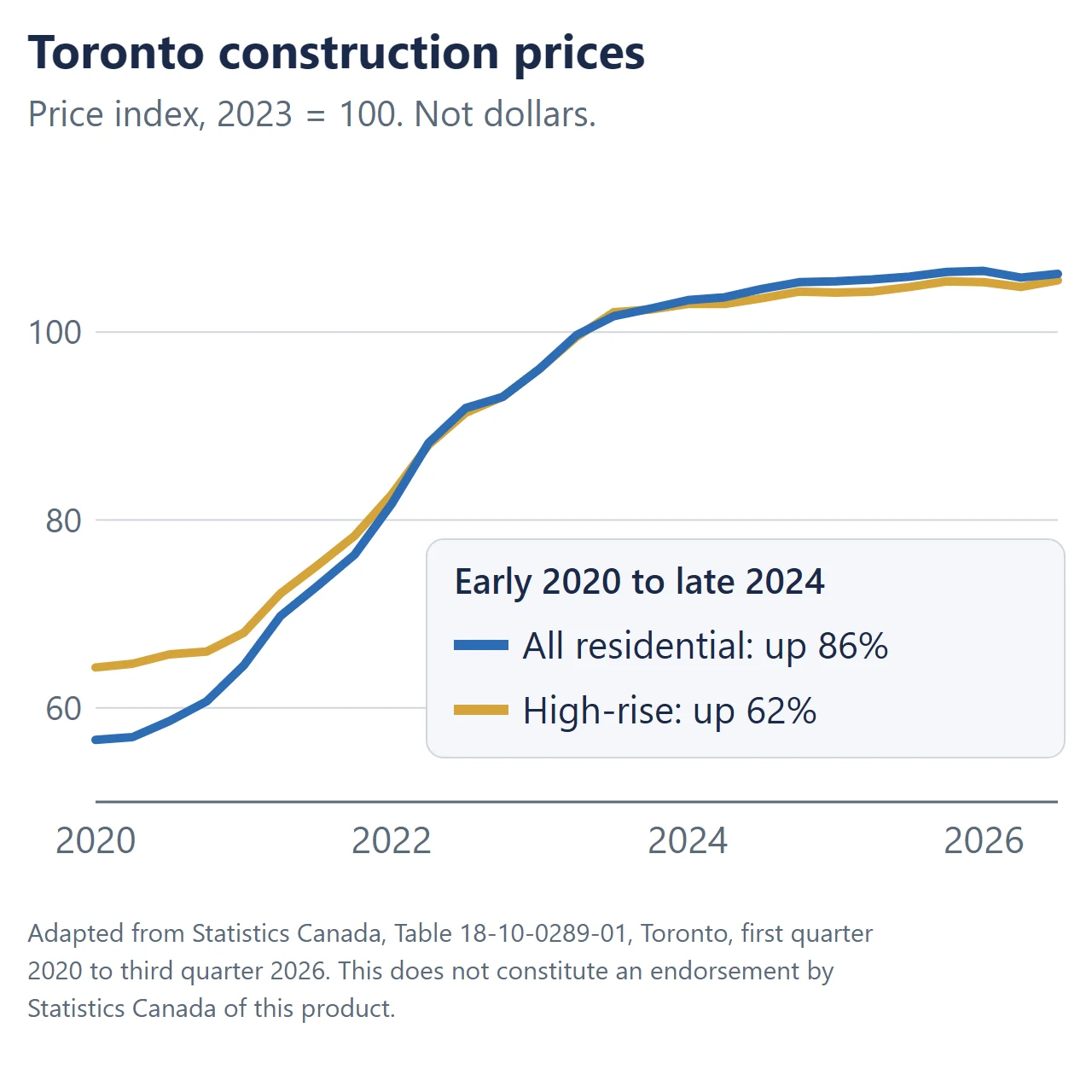
Adapted from Statistics Canada, Table 18-10-0289-01, Building construction price indexes, by type of building and division, Toronto, Ottawa and London, first quarter 2020 to third quarter 2026. This does not constitute an endorsement by Statistics Canada of this product. Percentages and dollar examples are calculated from the index values.
In the feature I used a simplified example: a $400,000 roof replacement put off from 2020 to 2024. On the residential index it could have cost about $744,000 by the end of that period. On the high-rise index it comes to about $649,000. Both figures show price changes alone, not the cost of any real roof.
Treat these indexes as a guide to direction, not a quote. Statistics Canada’s description of the index says it measures what contractors charge to build new buildings, which is not the same as repairing an existing one. The residential series also blends houses, townhouses and apartments.
Since late 2024, Toronto prices have been close to flat. The residential index rose less than 1% to the third quarter of 2026. Trades moved differently, though: on the high-rise series, thermal and moisture protection, which typically includes roofing, rose about 8% while concrete fell about 9%.
Outside Toronto the residential index kept climbing, by about 7% in Ottawa and 12% in London.
So the jump from 2020 to 2024 says little about what waiting from today will cost. If the engineer confirms the work can safely wait, deferring through a quiet market may cost little, and it avoids loan interest.
The risks are that no board knows when prices will move, and that existing damage can get worse while the money is saved. The corporation also has duties under the Act to repair after damage and to maintain the common elements, so a decision to wait needs the engineer’s advice behind it. Our article on unintended consequences in capital repair planning looks at other knock-on effects.
Option 2: levy a special assessment
A special assessment gives the corporation the money soon after owners pay their share, so the work can be scheduled. The CAO says a board can charge one without getting permission from owners, although the corporation’s governing documents may have provisions it has to follow.
The trade-off is the size and timing of each owner’s bill. An assessment can reach thousands of dollars per owner, sometimes far more, with little time to pay, though it can be split into instalments.
According to the CAO’s September 2024 reserve fund report, 724 condominium corporations responded to its survey. Of survey respondents, 16% reported issuing a special assessment to fund the reserve fund between 2018 and 2023, and 3% reported seeking a loan. The CAO cautions that the survey is not statistically representative of the whole condo sector.
As I noted in the feature, the cost generally lands on the people who hold units when the assessment is levied, even though later buyers enjoy the repaired building too. The sale contract and instalment timing can change who pays when a unit changes hands.
If the board leans toward an assessment, it helps to tell owners early what it means for a typical unit and when it will be due. Our guide explains how condo special assessments work.
Option 3: borrow through a condominium corporation loan
Borrowing can let the work go ahead sooner, with repayment spread over time through common expenses. The money is typically available once any required borrowing by-law is confirmed and registered, and the loan is in place.
In the CM Magazine feature I made the case that, for many owners, a steady monthly increase is easier to manage than one large bill, especially on a fixed income or with little in savings. Repayment over several years can also mean that owners who buy during the repayment period carry part of the cost of work they benefit from.
The cost is interest, and higher common expenses while the loan is repaid. A loan also does not replace reserve fund contributions, so the board should add the loan payment and any contribution increase together when it looks at the monthly change.
To compare the options fairly, a board can ask a lender for an estimate of the monthly change per unit and set it beside two other figures: the per-unit amount of an assessment and the expected cost of waiting.
A rough test is to set the loan’s yearly interest rate against the yearly price rise expected for that work, and to count any extra the fund earns by waiting. Then weigh any damage that waiting would add. In a quiet market, interest can cost more than waiting would. When damage is spreading or prices for that work are climbing, the reverse can be true.
The loan is made to the corporation and repaid through common expenses, so each owner still pays a share through their fees. With our reserve fund financing, there are no personal guarantees and no personal credit checks for owners.
Whether borrowing is the right fit depends on the corporation. For a closer comparison, see what boards should know about condo loans and special assessments.
The three options side by side
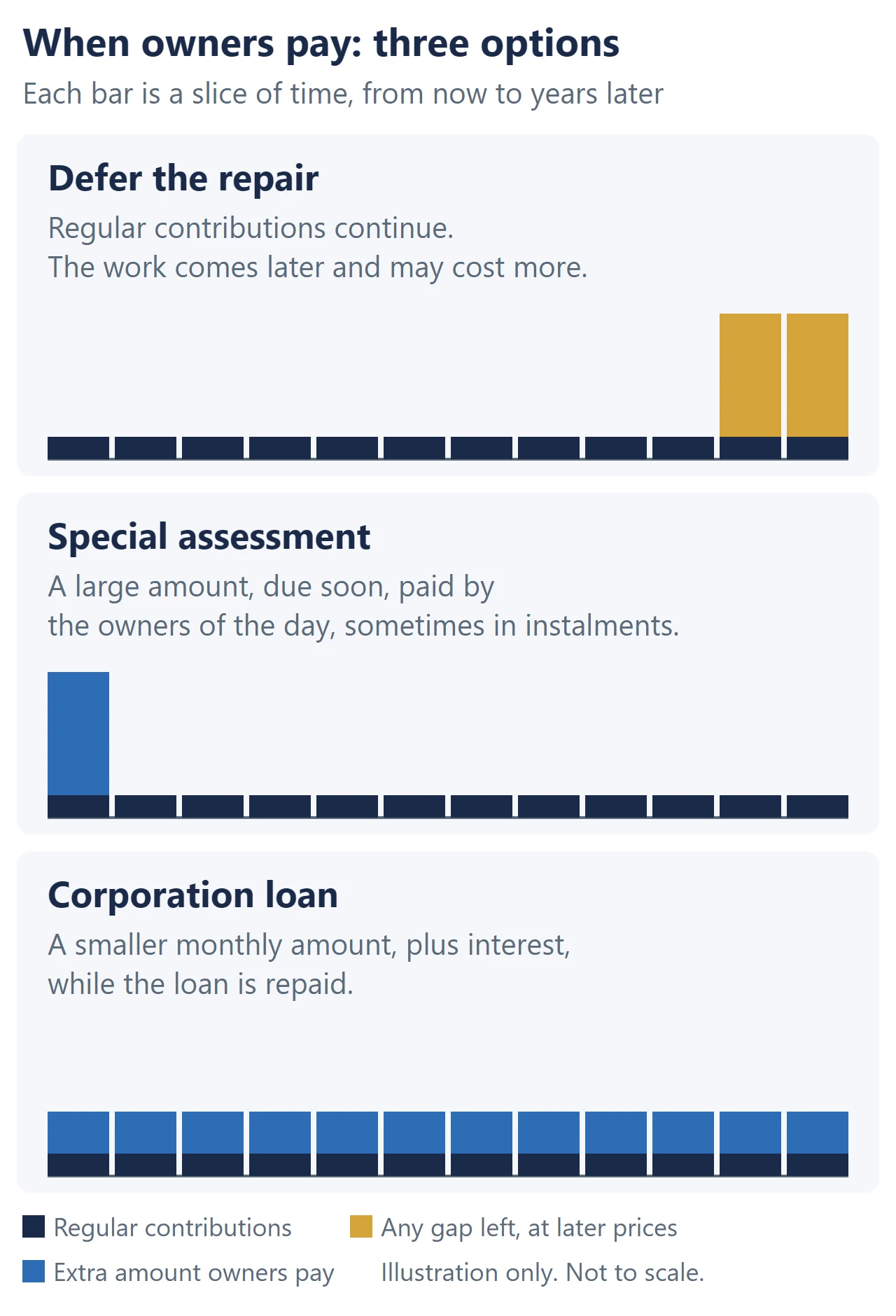
The right choice depends on the corporation and the work involved, and a board can use more than one option. Figure 2 shows how the timing differs, and the table below it sets out the typical trade-offs.
| What to compare | Defer the repair | Special assessment | Borrow |
|---|---|---|---|
| When the money is there | Later, as reserve fund contributions build up | Typically soon after owners pay their share | Typically once any required by-law is confirmed and registered, and the loan is in place |
| Who carries the cost | Owners through contributions during the wait, at whatever the work costs later | Owners who own units when it is levied | Current and later owners, through common expenses while the loan is repaid |
| Effect on owners’ monthly budget | Depends on the funding plan; contributions may still need to rise | A lump sum or instalments per owner, which may be thousands of dollars or more | Typically a gradual increase in monthly common expenses |
| Do owners vote? | Board decision, on professional advice | Generally no, subject to governing documents | Yes, when a borrowing by-law is needed |
| Main cost or risk | Prices and damage may grow while the work waits | Hardship for owners without savings to cover it | Interest, and an effect on future budgets |
A borrowing by-law brings owners into the decision
In Ontario, a loan for work outside the current budget needs a borrowing by-law, which also gives the board a structured way to explain the decision to owners.
Section 56(3) of the Condominium Act, 1998 says: “A corporation shall not borrow money for expenditures not listed in the budget for the current fiscal year unless it has passed a by-law under clause (1) (e) specifically to authorize the borrowing.”
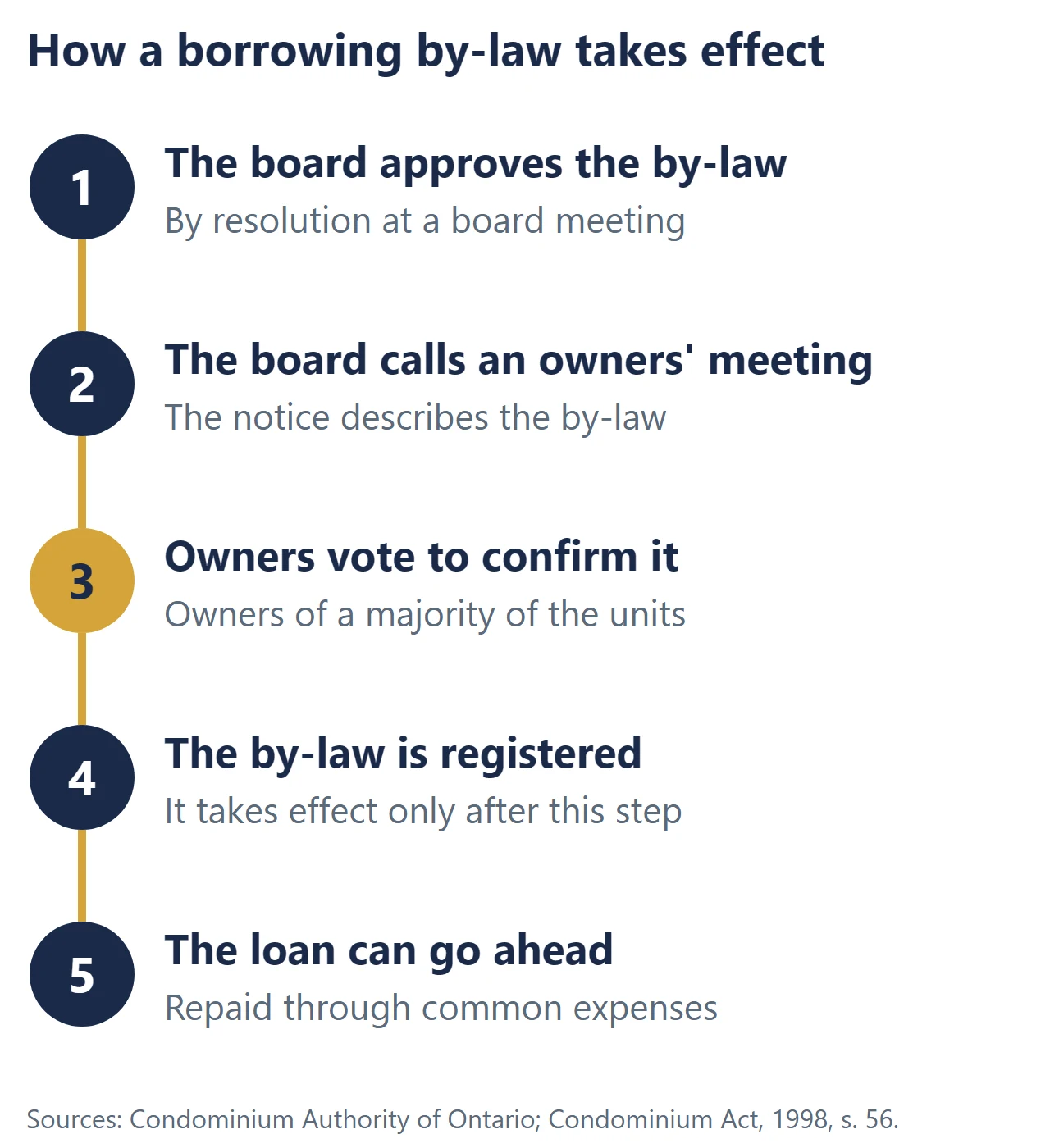
Under section 56(10), a by-law takes effect only when owners of a majority of the units in the corporation vote to confirm it and it is registered. The CAO states the same rule for borrowing by-laws. That means a majority of all units, not only of the owners who attend.
If owners do not confirm the by-law, it has no effect and the board needs another option.
The CAO’s page on by-laws sets out the by-law steps, and the board should confirm them with its condo lawyer before it starts:
- The board approves the by-law by resolution at a board meeting.
- The board calls a meeting of owners, and the notice describes the by-law.
- Owners vote on whether to confirm it.
- The by-law is registered.
The loan can then go ahead.
In the feature I suggested treating this process as an opportunity: “boards can use the process to clearly explain the project, why it’s needed, the anticipated cost, and the available funding options.” Our article on how to avoid ambushing owners with difficult news can help plan that message.
Put the decision on paper
Once the board has chosen, the funding should show up in the record. When the corporation next issues a plan for future funding, the Notice of Future Funding that goes to owners has a place for special assessment and loan contributions.
The status certificate matters too. The CAO reports that a Superior Court of Justice decision exempted a buyer in a Waterloo condo from their portion of a special assessment. The reason, the CAO says, was that the corporation had not clearly disclosed in its status certificate that it might need to levy assessments on owners.
Once a board knows a shortfall project is likely, it should ask its manager and lawyer how certificates describe it, whichever option it is leaning toward.
Questions to answer before the board chooses
These questions can help a board compare the options on facts, with input from its manager and professional advisers.
- How old are the cost estimates in the current reserve fund study, and do they reflect price changes since it was prepared?
- What does the engineer say about how urgent the work is, including any safety risk or further damage if it waits?
- Does the board have current quotes for the work, or only the study’s estimates?
- What would each option cost per unit, as a lump sum, in instalments and as a monthly change in common expenses, with any contribution increase included?
- What yearly price rise would make waiting cost more than the interest on a loan?
- How and when will owners hear about the problem and the options?
- Has the corporation’s condo lawyer reviewed the by-laws, the steps for a borrowing by-law and the wording of status certificates?
Talk to our team about your corporation’s numbers
A lender can walk the board and its manager through the options before anyone decides. If your board is facing a condo reserve fund shortfall and wants to compare them with the corporation’s own numbers, send our team a message through the contact form. You can also call 289-470-5513.
This article is general information, not legal or financial advice. Your condo lawyer, auditor and engineer can speak to your corporation’s situation.
About the author
Luka Milidragovic is Director and Condominium Finance Specialist at Condominium Lending Group, and a board member of CAI Canada and CCI Windsor. You can read more on Luka Milidragovic’s team profile, or read his full feature on the ACMO website.
Sources
All retrieved November 3 or 4, 2026.
- Luka Milidragovic, “Funding the Unexpected”, CM Magazine, Fall 2026, Association of Condominium Managers of Ontario.
- Statistics Canada, Table 18-10-0289-01, Building construction price indexes, released October 29, 2026.
- Statistics Canada, Building Construction Price Index survey description.
- Statistics Canada, Technical Guide for the Building Construction Price Index, 2023.
- Government of Ontario, Condominium Act, 1998, sections 56, 89, 90, 93 and 94.
- Government of Ontario, Ontario Regulation 48/01, sections 31 and 33.
- Condominium Authority of Ontario, Guide on Condo Reserve Funds.
- Condominium Authority of Ontario, Report on Reserve Fund Survey Findings, September 2024.
- Condominium Authority of Ontario, By-Laws.
- Condominium Authority of Ontario, Special Assessments.
- Condominium Authority of Ontario, CAO Concludes Successful 2025 Annual Meeting.